Showing posts with label Grateful Dead. Show all posts

Friday, December 27, 2024

Grateful Dead - Europe '72

 As you can see from the lack of activity here, this little hobby of mine may have run it's course. Between time restraints, health issues and just an overall lack of enthusiasm I just haven't been doing much. But, I do have a few more projects that I would like to put up so as the mood strikes I'll post them when I can.

So let's start with this one. Not too long ago my daughter gifted me a Sony Walkman music player to replace my ageing iPods. It's a nice little device that has a microSD slot that can handle high capacity cards. I currently have a 512gb card in there that is about 85% full so I might bump that up to a 1tb card one of these days. Having all that room allows me to carry around a lot of music including full discographies of all my favorite artists and more. But recently while building playlists I ran into a little conundrum that led to the creation of this album.

Back at the beginning of this blog I posted three Grateful Dead albums culled from early '70s solo and live albums collecting Dead songs never recorded for Dead albums. While building a playlist of just the Dead studio albums these were naturally included but I also wanted a playlist of the Dead plus Dead related albums which meant that if I include the solo albums and the albums I constructed from them I would have duplicate songs. If I excluded the fantasy albums I lose the tracks culled from the live albums. I could have just removed duplicates from the list but that would affect the ability to let the playlist play through each album as a whole. To rectify this I constructed this album.

Tracklist
 
Side One
01 Bertha
02 Hurts Me Too
03 Tennessee Jed
 
Side Two
01 Ramble On Rose
02 Chinatown Shuffle
03 You Win Again
04 He's Gone
 
Side Three
01 Jack Straw
02 The Stranger (Two Souls in Communion)
03 Wharf Rat
 
Side Four
01 Brown-Eyed Woman
02 Mr Charlie
03 (Walk Me Out In The) Morning Dew

Reality Notes

I started with the original songs and two covers unique to the Europe '72 live album. The Stranger (Two Souls in Communion) was included on CD reissues. I pulled Chinatown Shuffle from the Complete Europe '72 set while also auditioning all versions of Bertha and Wharf Rat but ended up using the Skull and Roses versions as none of the '72 versions had quite the same feel. I then included the awesome version of Morning Dew. Even though it breaks the "unique songs only" rule, the version on their debut album is very different.

I then arranged the songs to fit on four sides of vinyl with each side timing between 19:30 and 20:00 minutes. Each side gets a Pigpen song. Unfortunately there is only one song that features a Bob Weir vocal and that is shared with Jerry but the Garcia-Hunter team were in overdrive at this time and the bulk of Bobby tunes from this period appeared on his solo album so it is what it is.
 
This gives us a nice double live album in contrast to the sprawling triple disc original. Plus it will fit on a single CD if anyone still uses those. A great car album. I reused the cover from one of the reissues. Enjoy.

Thursday, October 22, 2020

Bob Weir - Chillin' With Bobby

Bob Weir is by far the most visible band member to carry on the torch that the Grateful Dead held high for so many years. Aside from the many post-Dead offshoots such as Dead & Co., The Dead and the Further Festivals and his many solo fronted bands like Ratdog, Bobby has hosted many artists in the extended Grateful Dead family and friends at Tri Studios (Tamalpais Research Institute).
 
Tri Studios is a state of the art performance venue. It also seems to be Bob Weir's home away from home when not on the road. Over the years of its existence Bobby has performed many times as a solo act, in special, one-off configurations with others or just sitting in with the band of the night. A nice handful of these performances are available on YouTube, most from 2013. I've gone through those shows and extracted Bobby's solo and small group performances with a focus on minimal, acoustic based tunes and gathered them into a two CD set that mimics a Grateful Dead show.
 
Tracklist
 
Disc One
01 Cassidy
02 Hell In A Bucket
03 Maggie's Farm
04 Stealin'>Deal
05 Most of the Time
06 Peggy-O
07 China Cat>I Know You Rider>Shakey Ground
08 Good Morning Little Schoolgirl
09 Loose Lucy

Disc Two
01 Sugar Magnolia
02 Cosmic Charlie
03 US Blues
04 Looks Like Rain
05 West L.A. Fadeaway
06 Easy To Slip
07 Black Throated Wind
08 Dark Star
09 El Paso
 
Bonus Tracks
Catfish John
When I Paint My Masterpiece

Reality Notes

My goal here was simply to collect relaxed, acoustic based performances where Bob is either the lead vocalist or at least a co-vocalist. There are a few duets here but mostly it's just Bob singing. Instrumentation is sparse if not solo. No more than a few other musicians on a song. The musician line-up is different from song to song. I refrained from listing the other players but you can get an idea of who's there by checking out the sorce list below.
 
I tried to keep the song choice interesting with some songs rarely played and maybe a few first timers. The classic/obvious choices are all unique due the the laid back, stripped down feel. Even songs like Dark Star or China Cat>I Know You Rider feel fresh and new. And the sound quality is incredible.
 
Cassidy was the driving force behind the compilation. It is one of my favorite Dead tunes and at the top of my list of Bobby songs but live renditions rarely match the feel and power of the studio version. This rendition not only matches the original for me but in some ways surpasses it. I've been looking for a vehicle for the track since I first heard it.

If you plan on burning this to CDs each set will fit on a disc. The bonus tracks will not. They were good enough to keep but not quite enough to be slipped into the main sets. If you play this from your computer or other device it makes a nice faux concert with each disc a set and the bonus tracks as the encore. I kept the bonus tracks because they were both nice renditions and Catfish John was seldom heard in my listening of Dead shows. Both not finding a spot in the main sets due to time constraints but too good to throw away.

For the cover I manipulated slightly a nice recent photo of Bob and added the text and logos. For the sources below I linked to the original videos. There is a lot of good music there. This could have been a three disc set but not everything would have been as revealing as the final set list. Enjoy.

Sources

Friday, January 17, 2020

Grateful Dead - Acoustic Dead 1971

"And you thought you were going to hear rock & roll..." JG 1970/02/07

Every time I think I'm done with the Dead something else punches me in the face demanding to be constructed.

In 1971 the Dead released a live album named Grateful Dead, AKA Skull and Roses. That album was compiled from a string of shows in April of 1971 but in 1969/70 they performed a series of acoustic sets, some planned and some impromptu. This live set is culled from those unplugged performances. A precursor to 1980's Reckoning which I feel they could have released in 1971 had these shows been recorded properly.

To be up front and clear, this is not a compendium of every song they played during the acoustic sets. Nor is it the best version of each song I chose to include (more on that below) or even the best songs they did. I did this to please myself first and foremost and I am happy with the results. This has been my pet project for a while vowing to myself to not share it until it was as perfect as I could make it. It goes without saying that if the band had planned ahead with the intention of releasing an album like this they would have recorded at least a few shows on 16 track tape and possibly even sweetened those up with new vocals.

Because this is suppose to be a vinyl release I sequenced and edited each side to have a continuous live flow. When two songs did not flow into each other well I used clips of audience noise from an audience tape to create the missing flow. In most cases it worked fantastic, in others you can hear the transition from one source to another but the applause feels like it belongs to one or the other song in the transition.

I used setlists to help with sequencing, putting songs where they would typically appear in an actual show. Though I used them to suggest rather than dictate. I tried to sequence each side to be independent yet contribute to the whole. I tried to create a balance between slow and somber songs and the more upbeat tunes. This comp has gone through several complete rebuilds and many subsequent overhauls and tweaks until I was happy with the tracklist and version selection.

Side One

01 Don't Ease Me In (Trad.)
- 1970-05-14 Meramec Community College - Kirkwood, MO
Right from the start when I first heard this take I knew it had to be the opener. If only for Pig on the harp. An amazing take. This song was often the acoustic set opener but this is one of only a few times Pigpen played harp on it. One of the few songs they played consistently from the very beginnings of the band up to the end. I used the Bill Graham intro from 1970-09-20 where he introduces the band as the Acoustic Dead.


02 The Rub (Hopkins)
- 70-05-15 Fillmore East, New York NY, [Early Show]
From Pigpen on harp to Pigpen on vocals and harp. This comp was almost subtitled "Hey Pig!" Pig would normally sit on the side during these sets but Jerry or Bobby would call him out to the stage with that phrase. I had initially planned to keep as many of those in but they ended up getting cut for time. An old Lightnin' Hopkns song actually titled Ain't It Crazy but the Dead always referred to it as The Rub.

03 I Know You Rider (Trad.)
- 1970-06-05 Fillmore West, San Francisco, CA
This song would normally follow Don't Ease but I felt it slowed things down too soon so I bumped it back one. A great rendition that almost takes it into Morning Dew territory. During electric sets they eventually pair this song with China Cat Sunflower that would become a standard until the end.

04 Friend of the Devil (Garcia/Hunter/Dawson)
- 1970-05-15 Fillmore East, New York NY, [Late show]
A nice early rendition. Jerry is still not sure of some of the lyrics but the song is there. I often chose early renditions of songs rather than later ones that sounded too much like the record. There was a show (9/20/70 ?) that had both David Nelson and David Grisman sitting in and they were able to recreate most of American Beauty very closely. Nice, but is it interesting?

05 Beat It On Down The Line (Fuller)
- 1970-05-02 Harpur College, Binghamton, New York
I don't know why but I really enjoy this song in all its incarnations. In this acoustic setting it still flies and has a nice charm about it.

Side Two

01 The Master's Bouquet (Baumgardner)
- 1969-12-26, Southern Methodist University, Dallas TX
At the beginning of the acoustic sets they weren't sure what to play so they dug up a lot of old folk songs, spirituals, country and blues numbers, many they used to play in their pre-Dead days. This is an old Hank Williams song.

02 Sawmill (Whatley/Tillis)
- 1970-01-31 The Warehouse, New Orleans LA
I added this one at the last minute. Originally I had Seasons in this slot but I felt I needed something a little more lively. Jerry plays electric guitar for this one. This show started electric then ended acoustic, the reverse of how they normally happened. This is also the only time the Dead played this live acoustically.

03 Truckin' (Hunter/Garcia/Weir/Lesh)
- 1970-09-20 Fillmore East, New York, NY
From the show with David Grisman sitting in. I've been led to believe that that is David on piano. A nice rendition somewhat close to the record if not slightly laid back.

04 Little Sadie (Trad.)
- 1970-02-28 Family Dog at the Great Highway, San Francisco, CA
A nice little folk song about a man who takes the life of some poor woman, runs from the law, is captured by the law and gets what 's coming to him. Death and murder songs seemed plentiful throughout the run of acoustic sets starting with Dupree and Dire Wolf. I had to pass on some great songs simply because all of the darkness was bringing the mood down.

05 A Voice From On High (Monroe/Mauldin)+
- 1970-05-15 Fillmore East, New York NY, [Late show]
The first track to feature David Nelson from NRPS on mandolin and harmonies. An old bluegrass tune by Bill Monroe.

Side Three

01 Black Peter (Hunter/Garcia)
- 1970-02-14 Fillmore East, New York, NY [Late Show]
Another song about death and bad luck. From Workingman's Dead a nice somber yet moving performance.

02 Silver Threads and Golden Needles (Reynolds/Rhodes)
- 1970-06-07 Fillmore West, San Francisco, CA
An old country standard first recorded by Wanda Jackson in 1956. The Dead played this often from '66 on but this is one of the last times it was played.

03 Cold Jordon (Rich)+
- 1970-06-07 Fillmore West, San Francisco, CA
An old gospel number popular with bluegrass groups like The Stanely Brothers. More commonly titled "Jordan" the Dead added the "Cold" to the title and spelled Jordan wrong. NRPS members sit in to add mandolin and harmonies.

04 Cumberland Blues (Hunter/Garcia/Lesh)+
- 1970-09-20 Fillmore East, New York, NY
David Nelson moves to guitar while Jerry plugs in.

Side Four

01 Dupree's Diamond Blues (Hunter/Garcia)
- 1969-04-05 Avalon Ballroom, San Francisco CA
This was soon paired with Mountains during the early sets of '69 and continued through November even after they stopped playing Mountains. Once the 1970 sets started they played this during the electric sets.

02 Mountains of the Moon (Hunter/Garcia)
- 1969-01-18 Playboy After Dark
This is another song that was on the must have list from the very beginning. This is my one cheater song. While it is live it is live in a TV studio. This was part of a Playboy After Dark episode. I wanted this version over all the others because it features Tom Constanten on the harpsichord. For a TV broadcast this was very noisy no mater which copy I used. I cleaned it up as best I could.

03 Katie Mae (Hopkins)
- 1970-02-14 Fillmore East, New York, NY [Late Show]
Another Pigpen spot. This time he plays the guitar to accompany himself for a true solo spot. During all of the acoustic sets, if Pigpen sang, he usually sang this one. He would sometimes do more but this was his goto song for these sets.

04 Wake Up Little Susie (Bryant/Bryant)
- 1970-02-14 Fillmore East, New York, NY [Late Show]
I rejected this song at first, it seemed a bit hokey maybe but I put it in after removing another song in this slot, Long Black Limousine, when I realized the set was already overloaded with death and murder songs. This helps lighten the mood a bit.

05 Uncle John's Band (Hunter/Garcia)
- 1970-02-11 Fillmore East, New York, NY
By the end of the acoustic sets in 1970 this song was more often than not the closing number. I got lucky and the audience tape I used for applause links ended with this song. They were playing it with full harmonies by then and I was able to use the end harmonies from the aud tape to supplement the end of this take to smooth out the transition to the end applause.

+ Features David Nelson and/or John Dawson from New Riders of the Purple Sage

Reality Notes

This post is one of my longer ones and it could easily be longer. There is so much to say about this that it could fill a small booklet.  Because of the size and scope of this project it is possible that I may have mislabeled a song source or two though I did my best to keep everything straight. Feel free to correct me if I did. I’m a freshman Dead scholar at best. If you want a more detailed description of the acoustic sets this is a great place to start.

A brief history of the 1969/70 acoustic sets starts in early 1969 when they started performing Mountains of the Moon. The song would appear randomly during the shows and was quickly paired with unplugged versions of Dupree's Diamond Blues, always played before Mountains, and Dire Wolf which also appeared during a few of these spots. By the end of the year Mountains had disappeared and after '69 Dupree was played electric and the acoustic sets briefly stopped.

But in late December the sets returned and came back big with longer sets and more songs and continued on through the next year. The first couple happened out of necessity due to equipment troubles or late musicians. By the end of the run they were longer and a bit more planned on with a typical show opening with an acoustic set then a short break then an electric set sometimes with a NRPS set between them. The length of the sets varied from show to show and not every show featured an acoustic set in the same spot, if at all.

At the start the sets were mostly just Jerry and Bobby but by the end the full band was involved with the drummers alternating from show to show. Pigpen always had a spot, usually Katie Mae but sometimes he would switch things up and throw a different blues number in the mix. They even did Operator four times but unfortunately those shows only circulate as audience tapes which prevented their use here.

There is a string of shows that featured the New Riders of the Purple Sage playing after the acoustic set. New Riders at this time still had Jerry and Mickey in the lineup. Often David Nelson and John (Marmaduke) Dawson would join them during the acoustic set, usually for a sacred number or a deep country cover. David Nelson would often switch from mandolin to acoustic guitar for Cumberland Blues while Jerry switched to electric. Jerry also played electric on this version of Sawmill.

When I started this project I had a few simple goals. One, no tracks that would duplicate songs from Reckoning or the two roughly contemporary live sets Live/Dead and Skull and Roses. I was fine with songs also appearing on Dead Set which was released about the same time as Reckoning as those would be electric and 10 years later. Two, the final run time must be between 75 and 80 minutes, long enough to justify a double vinyl album but still fit on one CD. And three was to not overload with too many new songs from the recent 1970 albums Workingman's Dead and American Beauty. Overall I knew my biggest challenge was to create a balance between clean recordings and good and interesting performances. Even after removing the duplicate songs from Reckoning and the other live albums and what appears here, there is still at least another single album's worth of songs leftover for a volume 2. I could have easily made a three disc set but then it wouldn't fit on a single CD.

There was another live album that most fans tend to forget about (I did). History of the Grateful Dead Vol. 1, Bears Choice was a single disc live album released in 1973, it contained some of these songs, one side acoustic and one side electric taken from Feb. 13 and 14 1970. I had chosen the same version of Katie Mae but it had some tape artifacts in it. The version of Black Peter I originally used had some flaws as well. The version of Wake Up Little Susie I originally chose was from a different show but this one was marginally better so I used these cleaner versions from the album though they weren't that much cleaner. I'm going to pretend that Bear's Choice never happened or it had different song choices. That album was assembled for Warner Bros to fulfill their contract, owing one more album to the label. So let's just say that this album filled that slot instead but released two years earlier.

It wasn't easy but I think I achieved that balance between good, interesting performances and sound quality but I still had to make a few compromises. When I started digging I found that this was not a good time for soundboards. Due to legal troubles, Owsley was absent for much of the tours outside of California leaving us with a lot of shoddy recordings and missing shows. The mixes were often unbalanced with the bass, drums and keyboards (if present) slightly buried but they’re there if you listen close. While it is fortunate that there was enough good sounding shows to choose from, the best shows were not always captured well if at all. The last three sets in November exist as audience tapes only. While I passed on using those for quality reasons there are a couple aud tapes that almost sound as good as the soundboards (here's a nice one from 11/08 I used applause clips from this one to help smooth out the song transitions). So, while the final results here may not be as pristine and perfect as I'd hoped, I'm very happy with how it did turn out and feel lucky to be able to pass it along to you.

The cover was constructed from several elements but the main center image comes from a floor mosaic by Gianlorenzo Bernini in the Cornaro Chapel Rome, Santa Maria della Vittoria. John Hilgart over at Save Your Face recently used the image for a post and I fell in love with it and extracted the center image for this cover. I had originally planned to name this after the working title of Aoxomoxoa with the cover to the left but when I changed the image the title didn't work for me anymore so I changed it to simply Acoustic Dead. There were vinyl bootlegs with the same name featuring one of the many acoustic sets from 1970 so it all felt proper to me. And before anyone points out the the working title of Aoxomoxoa was Earthquake Country not County I felt county rolled off the tongue and fit the image better.

Friday, January 10, 2020

Bob Weir Band [Grateful Dead] - Acoustic 1978

Another rare acoustic set for The Dead. This time from 1978. The Dead were in the middle of a three night run in Chicago when they did this impromptu performance earlier in the day. Billed as the Bob Weir Band but really the band minus Keith, Donna and Bill.

The show was a benefit for the college's Hunger Week and saw the band dig out some old favorites and a couple of new ones and one original and that was a Bobby song from his recent solo album, Heaven Help The Fool.

I love acoustic music in general but acoustic Dead always seems like something special. Enjoy.

Side One
01 Whinin' Boy Blues
02 Tom Dooley
03 This Time Forever
04 Deep Elem Blues
05 KC Moan

Side Two
01 Knockin' on Heaven's Door
02 Big Boy Pete
03 Jack-A-Roe
04 Dark Hollow
05 Oh Boy

Reality Notes

Not too much more I can say about this one. It's a fun listen and unlike other shows I've edited This one was pretty tight with very few long bits between songs. The recording is a clean and decent soundboard which required no touching up. The song choices are mostly old folk and blues songs with one original. Many are making their first and last appearances.

I wanted the cover to have a bootleg feel. This is pre-CD era and their label Arista was still pushing them to deliver slick production product so this would never see an official release making it perfect bootleg material. Even before doing my usual trimming of between song chatter this was barely over 45 minutes long and would split nicely between songs five and six on a vinyl disc. For this reason I did not try to smooth out every edit. I imagine the bootlegger had rudimentary tape editing skills and just chopped what he could to make it fit on the disc.

Friday, January 3, 2020

Phil & Friends [Grateful Dead] - Unplugged '94

To ring in the New Year for the next three weeks I'll be posting nothing but acoustic Dead. This is leading up to something special I've been working on for a while now that I'm really excited about.

My favorite part of the Dead is when they just get down to it and play songs. I love the jamming if I'm in the right mood but the songs will always lift me up when I'm feeling a bit low. And in an acoustic setting we get more songs than jamming. I'm also a big fan of acoustic music in general so acoustic Dead seems to be a natural fit for me.

On September 24th, 1994 the Dead played an acoustic set at Berkeley Community Theatre. Billed as a Phil & Friends show, it featured everyone except the drummers. The setlist was a nice mix of old and new songs. As a prelude to a future Dead post that is just about ready I thought I would share this.

Acoustic sets were rare occurrences for the band outside of 1970 and 1980. The latter giving us the wonderful Reckoning album. I'm working on 1970. There was also a 1978 set that I will be posting next week. I've seen some nice alternate Reckoning comps out there. I encourage you to seek those out if you're into this but I don't see them as essential, just more of a good thing.

Tracklist

01 Tuning & Bob Weir intro
02 Walking Blues
03 Lazy River Road
04 K.C. Moan
05 Dupree's Diamond Blues
06 Childhood's End
07 When I Paint My Masterpiece
08 Attics Of My Life
09 Cassidy>
10 Bird Song>
11 Throwing Stones

Reality Notes

A nice, tight, one hour set that is a treat to listen to. It's nice to hear Vince just playing piano with no midi stuff in sight. Everyone is in fine form. Some songs to note; Lazy River Road and Childhood's End are songs that were considered for the final album that never happened. For those that have/are constructing that album I recommend this Childhood's End as the version to use. Phil's voice is a bit more relaxed which makes him easier to listen to. Cassidy>Bird Song is just wonderful. And a beautiful version of Masterpiece as well. The whole set is just a great listen. If you like acoustic Dead then you need this.

As always with live shows I trimmed the between song tuning and chatter to help the overall flow. I'm visualizing this as a gray market CD rather than trying to pass it off as an official release. That gives me some wiggle room on overall quality and editing.

I threw the cover together featuring a pic from the event. There was a better, clearer version but it was cropped at the top so wouldn't fill the cover like I liked. I think it completes the gray market feel I was going for. Enjoy!

Friday, October 12, 2018

Grateful Dead - Day Job - 1995

[UPDATE: I've made enough changes to this album to justify an updated archive. Something I rarely do. I've removed the two songs I was never quite happy with: Keep Your Day Job and Samba In The Rain and swapped the version of Days Between with a new edit by John Hilgart over at Save Your Face. Overall the album feels more concise and consistent from front to back. On Nov. 22nd the band will finally release their version. With only 9 songs but still long enough to make it a double vinyl album due to using all live version it still seems long to me but at least we'll finally have the band's input.]

Last week I addressed The Grateful Dead's hypothetical first album so I thought it appropriate that I take a look at their last. I've been seeing a lot of constructions of what could have been the last Grateful Dead album before Jerry Garcia passed away. I enjoyed all of them but none of them satisfied me completely for one reason or another so I decided to throw my hat in the ring.

In 1995 The Dead had begun the process of recording their next album. According to interviews they had barely gotten past the stage of laying down the foundation when Jerry checked out. While ideally it would be best to polish off those recordings, Jerry never got around to doing his vocals or solos which renders the album impossible to finish from the band's perspective.

Fortunately for us all songs in contention were played live on many occasions. The band recorded every show which gives us plenty of source material to construct a facsimile of what the album could have sounded like. Interpretations of this album vary and production was still in its early stages so the only clues we have from the band is a list of potential songs in no particular order.

01 Lazy River Road (Jerry Garcia/Robert Hunter)
02 Corinna (Bob Weir/Mickey Hart/Robert Hunter)
03 Wave to the Wind (Phil Lesh/Robert Hunter)
04 Easy Answers (Bob Weir/Bob Bralove/Rob Wasserman/Vince Welnick/Robert Hunter)
05 If the Shoe Fits (Phil Lesh/Andrew Charles)
06 So Many Roads (Jerry Garcia/Robert Hunter)
07 Way to Go Home (Vince Welnick/Bob Bralove/Robert Hunter)
08 Liberty (Jerry Garcia/Robert Hunter)
09 Eternity (Bob Weir/Rob Wasserman/Willie Dixon)
10 Days Between (Jerry Garcia/Robert Hunter)

Reality Notes

The first version of this album I heard was Days Between (The Final Album That Never Was), by Tony Sclafani, author of The Grateful Dead FAQ book. This remained my goto version right up to when I started my construction. What I liked most about Tony's construction was his use of shorter length versions over longer jams even when the longer version was better. This allowed all 12 tracks to fit comfortably on one disc.

I think my growing dissatisfaction came down to sequencing, not enough Jerry and too much Phil. As a bass player Phil sits among my pantheon of bass gods but I have never been a fan of his voice and there were three Phil songs. To rectify this I dropped Phil's Childhood's End (the worst offender) and added Keep Your Day Job. I'm well aware of the controversy over Day Job but I have always liked the song and feel it is mostly misinterpreted by those who speak against it (if you're one of those then just delete the song and you'll still have a full album). I swapped a few other versions and shuffled the songs around until I had a good flow from track to track.

I have been enjoying this construction, I'm very pleased with how it came out. It's amazing how swapping out a few songs can complete an album. My only complaint would be its length. At just over 72 minutes it is quite hefty but this is the swan song of one of rock's most iconic bands so I'm willing to let the length slide. It fits on a CD and it's The Grateful Dead. I'm Happy.

There's still a few scraps out there to collect together. I had the cover song Women are Smarter in contention but in the end went with an all originals tracklist. If someone could find a version of Childhood's End where Phil doesn't sound like an average bar band singer let me know. It's an OK song and is filler worthy but time constraints and subpar vocals pushed it out of contention for this construction.

The cover again utilizes a tour poster graphic with added text by me. I like using tour poster art because I feel it's the closest we can get to official artwork and band promo photos don't always make good album covers.

Hindsight

I was going to add these hindsights chronologically but I wanted to address this album specifically because it is the only one that I have changed since posting. after some further listens it still felt long. I've since dropped Day Job and Samba In The Rain. As much as I like Day Job neither song seemed to fit. I'm not updating the download so if you want to play along you can just delete those songs. Eventhough I'm dropping the title song I'm keeping the album as named. It's a cool name and kind of a tribute to one of my favorite songs of this period that never found a home. This does mean that there are still a small handful of post Built To Last songs that are still unused. Hmmm.

A recent post on the Save Your Face blog led me to an acoustic Dead show on 09/24/1994 at The Berkeley Community Theatre that was billed as a Phil and Friends show but was The Dead minus the drummers. During the set they did a version of Phil's Childhood's End that is for me the most listenable version I've heard yet. If I were to make a comp of what's left I would go with that version. They also did a fine version of Lazy River Road that is almost as good as this one but not enough to replace it. It would have been nice to have at least one acoustic number on the album.

Is it on my iPod? Yes. The Dead is one of the few bands that I have their full studio discography with me at all times including all of the constructions here. It gives me a fuller picture of the band I feel and makes for an interesting listen when on shuffle.

Friday, October 5, 2018

Grateful Dead - Alt Debut -1966

[I was just putting the finishing touches on this when Paul at Albums That Should Exist posted three albums of '65-'66 Dead. So if you want more check him out.]

I thought I was done with The Dead but I discovered this album hiding in plain sight. The Grateful Dead released their major label debut in 1967 but that was not the beginning of their recording career.

The 2001 box set  The Golden Road (1965–1973) contained two bonus discs titled The Birth Of The Dead that was later released separately as a two disc set. One disc contained studio tracks and the other contained live tracks Both from 1965-66 before they recorded their Warner Brothers label debut.

Between those two discs and a couple stray tracks from other sources, I was able to put together what could have been the first Grateful Dead album, released on Scorpio Records who released their first single before signing to WB.

Side One
01 Alice D Millionaire 5
02 Mindbender (Confusion's Prince) 1
03 I Know You Rider 1
04 Early Morning Rain 1
05 Can't Come Down 1
06 Pain in My Heart 4

Side Two
01 You See a Broken Heart 3
02 On The Road Again 4
03 Tastebud 2
04 The Only Time Is Now 1
05 You Don't Have to Ask 2
06 Standing On the Corner 4

Single
A. Don't Ease Me In 2
B. Stealin' 2

Reality Notes

I love archival releases but they seldom lend themselves to repeated listens due to their focus on preserving every meaningful scrap they can find. The Birth Of The Dead is no exception. While disc two can see some regular listens, disc one suffers from the unfortunate side effect of the archival process. What we have on that disc includes multiple versions of many of the songs including instrumental versions. While that's great for research and gaining new insights into your favorite bands, with each listen the skip button is pressed more often.

But sometimes, after a few listens, a group of songs coalesce into an entity of its own. And it is that scenario that is one of the many reasons for what we do here. This is an effort to rescue songs that deserve to sit within the official cannon that otherwise would be buried and possibly forgotten among some less polished gems.

The bulk of these recordings come from two sets of studio sessions. The first was in late '65 for Autumn Records and the second in late spring of '66 for Scorpio Records. Two songs from the Scorpio sessions, Don't Ease Me In and Stealin', were released locally as a single which I have included as bonus tracks. The rest of the album is filled out with live tracks (it wouldn't be the last time). Many of these songs continued to be setlist regulars for the remainder of the band's career.

The one anomaly (there's always one, isn't there) is the opening track, Alice D Millionaire. This recording comes from the sessions that gave us the Warner Brothers debut although notes say it was played live in '66 which makes it fair game to use. I added it for a few reasons. Mostly because it is an original song and fit in stylistically and I didn't want it to get lost in bonus track limbo.

I struggled with a title for the album before giving up and leaving it untitled. They later named two other albums the same name, one was their WB debut and the other was a live album that is more commonly referred to as Skull and Roses so why not add to the confusion? Maybe the fans would have given it a nickname to set it apart. Think of it as a false start. The cover uses elements from a tour poster, an old promo pic and some clipart roses.

1 Autumn Records sessions November 3, 1965 at Golden Gate Recorders in San Francisco
note: tape box lists artist as: The Emergency Crew; a short-lived name the band used immediately prior to "Grateful Dead"
2 Scorpio Records sessions June 1966 at Buena Vista Studio in San Francisco, and Western Recording in San Francisco
note: Don't Ease Me In and Stealin', were previously issued locally (in limited quantity), in July 1966, as the Grateful Dead's first single (Scorpio Records #201), with Don't Ease Me In on the A-side. Included here is the "dry mix" - the single was mastered with added reverb. I Know You Rider was also recorded during these sessions.
3 Studio recording, early 1966 (from Rare Cuts and Oddities 1966)
4 Live tracks recorded in 1966 at the Fillmore Auditorium in San Francisco, On The Road Again is from Los Angeles, California
5 Outtake from the WB Grateful Dead sessions 1967. A version of Tastebud was also recorded during these sessions.

Friday, July 13, 2018

Grateful Dead - Barton Hall May 8, 1977

Ah, Barton Hall '77. A general consensus puts this show at the top of the must hear list of Grateful Dead shows. Not so much for the performance, which is great but no more stellar than your average typical Dead show, but more for the atmosphere and the recordings themselves. There is a warm fuzzy feeling that surrounds this show. Much of that is most likely due to the fine soundboard recordings of Betty Cantor-Jackson.

This show has been officially released on May 5, 2017 as both as a stand alone package and as part of a four show, eleven disc box set. If I could make one complaint about live Dead it is the long gaps between songs and this show is no exception. If you are there in the audience and in the heat of performance this is fine but on playback the gaps just take me out of the show until the band kicks in again.

I'm all for archival preservation but when this show was released it takes up three discs due to those long pauses between songs. What I've done here is to remove those pauses to make a smoother listening experience. For those songs that do not run into each other I have made new transitions to reduce the gaps to no more than a few seconds. Each set should fit on a single 80 minute CD though set one is awfully close. Let me know if it works for you and make sure to burn the disc with no gaps. I did not use the official release for this edit. Instead I used a matrix recording from the Internet Archive.

Set One
01 Minglewood Blues
02 Loser
03 El Paso
04 They Love Each Other
05 Jack Straw
06 Deal
07 Lazy Lightning >
08 Supplication
09 Brown Eyed Women
10 Mama Tried
11 Row Jimmy
12 Dancin' In The Streets

Set Two
01 Take A Step Back
02 Scarlet Begonias >
03 Fire On The Mountain
04 Estimated Prophet
05 Saint Stephen >
06 Not Fade Away >
07 Saint Stephen >
08 Morning Dew
09 Saturday Night(Encore)

For the cover I utilized elements from a tour poster.

Friday, February 23, 2018

Grateful Dead - Terrapin Station Live - 1977

Terrapin Station was the Grateful Dead's ninth album. While generally well received, the band, the critics and the fans were a bit perplexed, annoyed, even a bit angry about the production values of the LP in general. Especially the band.

After the folding of their own record label the Dead signed with newly formed Arista records. One of the contingencies set by label president Clive Davis was that the band must work with a producer on the next record. Something they hadn't done since their third album Aoxomoxoa. They settled on Keith Olsen who had just finished producing Fleetwood Mac's first LP with Lindsey Buckingham and Stevie Nicks. Clive's one instruction to Olsen was that he wanted a commercial record.

Keith Olsen's production style clashed with the Dead's recording style right from the start. Olsen wanted the band to do 20 takes until it was perfect while the Dead would just play it until it felt good. Once principal recording was done Olsen layered on strings and horns in ways the Dead never did and pushed them to the front of the mix. It was this over the top production that prompted me to see if this project was possible. So what would it sound like if the Dead played the album live in its entirety with no overdubs?

01 Estimated Prophet [1977-03-18 - Winterland Arena]
02 Dancin' In The Streets [1977-05-15 - St. Louis Arena]
03 Passenger [1977-06-08 - Winterland Arena]
04 Samson and Delilah [1977-03-18 - Winterland Arena]
05 Sunrise [1977-05-09 - War Memorial]
06 Terrapin Station [1977-03-18 - Winterland Arena  (end coda 1977-12-29 - Winterland Arena)]

Reality Notes

To make sure that this construction was even possible I first had to confirm that every song on the album was performed live. Thankfully they were. My next task was to track down all performances and whittle them down to the best versions. I limited myself to 1977 which was the year of release for the album itself so the songs would be their freshest. Keith and Donna left the band in 1978 after the next album. Once they left Donna's Sunrise was retired from the setlist.

I trawled through the live Dead collection on the Internet Archives looking for the best sounding shows. I ended up going with matrix sources which consist of soundboard recordings synced up with audience tapes as they tended to have a better and fuller live feel to them.

For the core I used the 1977/03/18 Winterland Arena show. I chose this show because they played three of the six songs that night and this was the most complete Terrapin Station suite they ever played. Unfortunately this version ends with drums then segues into Not Fade Away instead of reprising and resolving the suite. To fix this I tacked on the end of the performance of this song from 12/29 after finding a good spot during drums to segue back into the song. A slightly dodgy edit but it works.

I then chose the best versions of the remaining songs that struck the best balance between performance and sound quality that would blend well with the tracks from 3/18. Sunrise proved the most problematic. Not because of poor performances but due to the fact that most recordings (even soundboards) had Donna's vocals mixed almost to the point of being inaudible. (I know some of you think that that would be a good thing but I mostly like her voice.)

Even though these are live recordings I did my best to simulate a studio album by trimming as much of the audience that I could. I did attempt to create a full live version that kept the crowd in but the results did not come out as well as I had hoped. I also did not attempt to edit these songs down to match the original album lengths. While my editing skills might be capable I find it hard to edit Jerry when he's in the zone. Which is why we have a 16 minute epic version of Dancing in the Street and an overall length of 55 minutes. Maybe that's a task for John Hilgart over at Save Your Face. He excels at getting to the best parts of a performance.

The cover is a collage of several elements from the original. I wanted to keep the original cover but also wanted it to be different. Love those turtles.

Thursday, November 23, 2017

Grateful Dead - Souls In Communion - 1973

To celebrate our feast day (Thanksgiving) here in the States here is a second helping, and our final installment of Grateful Dead.

Again only a few months after the Europe ’72 live album and six months after the last album Ace the Grateful Dead released another solid album. This is the first, and possibly only album to feature more songs from other members than Jerry Garcia with four songs from Bob Weir and another from Ron "Pigpen" McKernan and three from Jerry. This is also the last album to feature Pigpen who due to failing health left the band about this time and passed away soon after.

Side A
01 Cassidy– 3:40
02 He's Gone – 6:53
03 Comes a Time – 6:21
04 Black-Throated Wind– 5:43

Side B
01 They Love Each Other– 4:36
02 Walk in the Sunshine - 3:05
03 Looks Like Rain– 6:08
04 The stranger (Two Souls in Communion) – 6:46

Reality Notes

With four Bob songs this album should really have been called Ace, especially with Cassidy leading it off. I have always identified that song with that album even though there are plenty of other songs on that album that became setlist staples. They didn’t even play Cassidy live until 1974 which is one reason it appears here. I tried to swap it with a Jerry song from Ace but the only song close to this length was another Bob song. All of Bob’s songs here date from March 1972 either debuting live or on record at that time. Walk in the Sunshine was never played live by the band.

The three Jerry songs each come from a different year. Comes a Time debuted live in 1971 but this studio recording is from 1975. He’s Gone was played live for the first time in April of 1972. They Love Each Other is our one true anomaly. When it debuted in February of 1973 the arrangement was different. It was faster and more of a straight forward rock boogie in the vain of Pigpen’s Mr. Charlie. They stopped playing it shortly after its debut. When it was recorded in 1975, our version here, it was slowed down and the guitars were given more distinctive arrangements. When they started playing it live again after 1975 they slowed it down even more. This song was the real catalyst for this comp. I love this song and wanted it firmly in the dead catalog where it belonged. Because we are setting a March 1973 release date we have to imagine that it skipped its early arrangement.

Closing the album is Pigpen. A majestically soulful song that was only played live. It was at the beginning of 1973 that Pigpen took time off from the group to concentrate on his health. Sadly, he was never able to return. Pigpen passed away in March of 1973. I think it is a fitting tribute to have Pigpen finish this album with such a great song.

I struggled with this cover for a while. I had the picture and tried to balance the band name and title until I came on the idea of wrapping the text around the circle. The frame was the finishing touch that really made it come alive.

Sources
Reflections (Jerry Garcia)
Comes a Time
They Love Each Other
Ace (Bob Weir)
Cassidy
Black-Throated Wind
Walk in the Sunshine
Looks Like Rain
Europe ‘72
He's Gone
Complete Europe ‘72
The stranger (Two Souls in Communion)

Grateful Dead - Ace - 1972

Released six months after the last album Ramble on Rose the Dead again delivered an album packed with great songs. Sessions began prior to a two-month tour of Europe (with a full entourage and a 16 track tape recorder to capture every show). A few more studio sessions after the tour to polish up the album to give to the label and they were off on another tour. Truly, in 1972, the music never stopped.

Side A
01 Deal– 3:09
02 Jack Straw– 4:47
03 Mexicali Blues – 3:33
04 Tennessee Jed– 7:08
05 The Wheel– 4:03

Side B
01 One More Saturday Night– 4:28
02 Brown-Eyed Woman– 4:38
03 Sugaree– 5:52
04 Chinatown Shuffle – 2:38
05 Bird Song– 4:26

Reality Notes

The songs here span from February 1971 to March 1972. While most of the songs come from the same three, core sources as the last album, two songs are from the Complete Europe ’72 box set. I went for the live version of Mexicali Blues to avoid the mariachi brass on the studio version. This has always been the weak spot of the Weir album for me so if I could keep the song but lose the horns, I’m happy. This version emulates the horns nicely without being in your face, so I felt it was a good replacement. Chinatown Shuffle is a Pigpen song that was never released on an album during his lifetime. Always good to have a Pigpen song.

Jack Straw is the reason why I had to rethink this time line in the first place. It was during the European tour when Bob and Jerry started to trade verses. Before that Bob had sung all the verses. It is for this reason that the release date of this album is placed after the tour.

I decided to reuse the Ace title for the album to keep a toe in reality. This is not an alternate Bob Weir album though. Even though the Dead played on all the songs on Bob’s LP, he did write all the songs. Here we have what could have been a band album. Because I was keeping the name I decided to keep the artwork as well, with some modification of course.


Sources

Garcia (Jerry Garcia)
Deal
Sugaree
The Wheel
Bird Song
Ace (Bob Weir)
One More Saturday Night
Europe ‘72
Jack Straw
Tennessee Jed
Brown-Eyed Woman
Complete Europe ‘72
Mexicali Blues
Chinatown Shuffle

Saturday, November 18, 2017

Grateful Dead - Ramble on Rose - 1971

As the follow up to American Beauty, Ramble on Rose had a lot to live up to and succeeded on all counts. Released in November of 1971, six months after the live album Skull and Roses and a year after American Beauty which itself was released only five months after Workingman’s Dead. The Grateful Dead were certainly on a roll with no signs of slowing down.

It’s amazing they had the time to even record with all the touring they were doing. It turns out that several of the songs were recorded live then sweetened in the studio later. The live tracks were recorded on 16 track tape, the first band to do so, which gave them the separation needed to make room for overdubs later. They would employ this method on the next two “studio” albums that would be released in the following year.

Side A
01 Bertha – 5:39
02 Ramble on Rose– 6:00
03 Playing in the Band– 7:36
04 Mr. Charlie– 3:36

Side B
01 Greatest Story Ever Told– 3:40
02 Loser– 4:05
03 Wharf Rat– 8:32
04 To Lay Me Down– 6:18

Reality Notes

No editing done on this one beyond trimming beginnings and endings and some volume matching. We are setting a release date for this album for sometime in November 1971. This allows us to use Ramble on Rose which had its live debut on October 21st the previous month. The oldest song, Playing in the Band, made its live debut two years before as a 10 minute instrumental on November 8th 1969. The sources for these versions are as follows:

Skull and Roses
Bertha
Wharf Rat
Garcia (Jerry Garcia)
Loser
To Lay Me Down
Ace (Bob Weir)
Playing in the Band
Greatest Story Ever Told
Europe ‘72
Ramble on Rose
Mr. Charlie

I had two versions of To Lay Me Down and Playing in the Band to choose from. Both were shorter than those used. To Lay Me Down was an outtake from American Beauty. I really wanted to use it but it just wasn't ready production wise so I went with the Garcia version. Playing in the Band was originally released on Skull and Roses and was just under five minutes but I went with the Ace version. If I did go with the shorter versions I could have slipped another song in.

The cover features a picture from Stanley Mouse. As a follow up to American Beauty I wanted to emulate that cover in some way so I included the wood background.

Saturday, November 11, 2017

Grateful Dead - 1971 - 1973 Pt. 2

Because of the complexity of this project I thought I would use it to give a peek into my process.  While each project is different the more complex the project, the more planning and research involved.

Every project always starts with an idea that can be expressed with a what-if question. What if Crosby, Stills, Nash and Young had completed Human Highway? What if The Beatles recorded one more album? What if KISS dropped the Elder concept album and returned to a heavy sound like originally planned?

Most of these questions are triggered by a bit of passing trivia such as the fact that 1973 was the last time that all four Beatles released new albums in the same calendar year. This project was spurred on by the fact that between American Beauty (released Nov 1971) and Wake of the Flood (released Oct 1973) the Dead released two solo albums and two live albums. Each of these live albums contained enough new songs, never recorded in the studio, to fill a single album. The solo albums were not so solo. Jerry played everything but drums on his and Bob’s album was solo in name only and the fact that he wrote and sang all the songs. So, what if they released albums under the band name containing all of the new songs?

Once the question is formed I look at the time line in question to see how everything fits to get an idea of how the reconstructed albums might look. In this case I’m putting the first two new albums roughly in the same place as the two solo albums with the third being placed between Europe ’72 and Wake of the Flood. The live albums are not going away. I’ll address those in a moment.

Because I am a visual person, if needed, I’ll make some charts and tables to help me organize everything. The table below shows the release schedule of all the albums between 1969 and 1974. I did this to see how often they released albums. In general, as was the norm of the time. They released one or two albums each year roughly 6 months apart. Usually in May or June and in October or November.


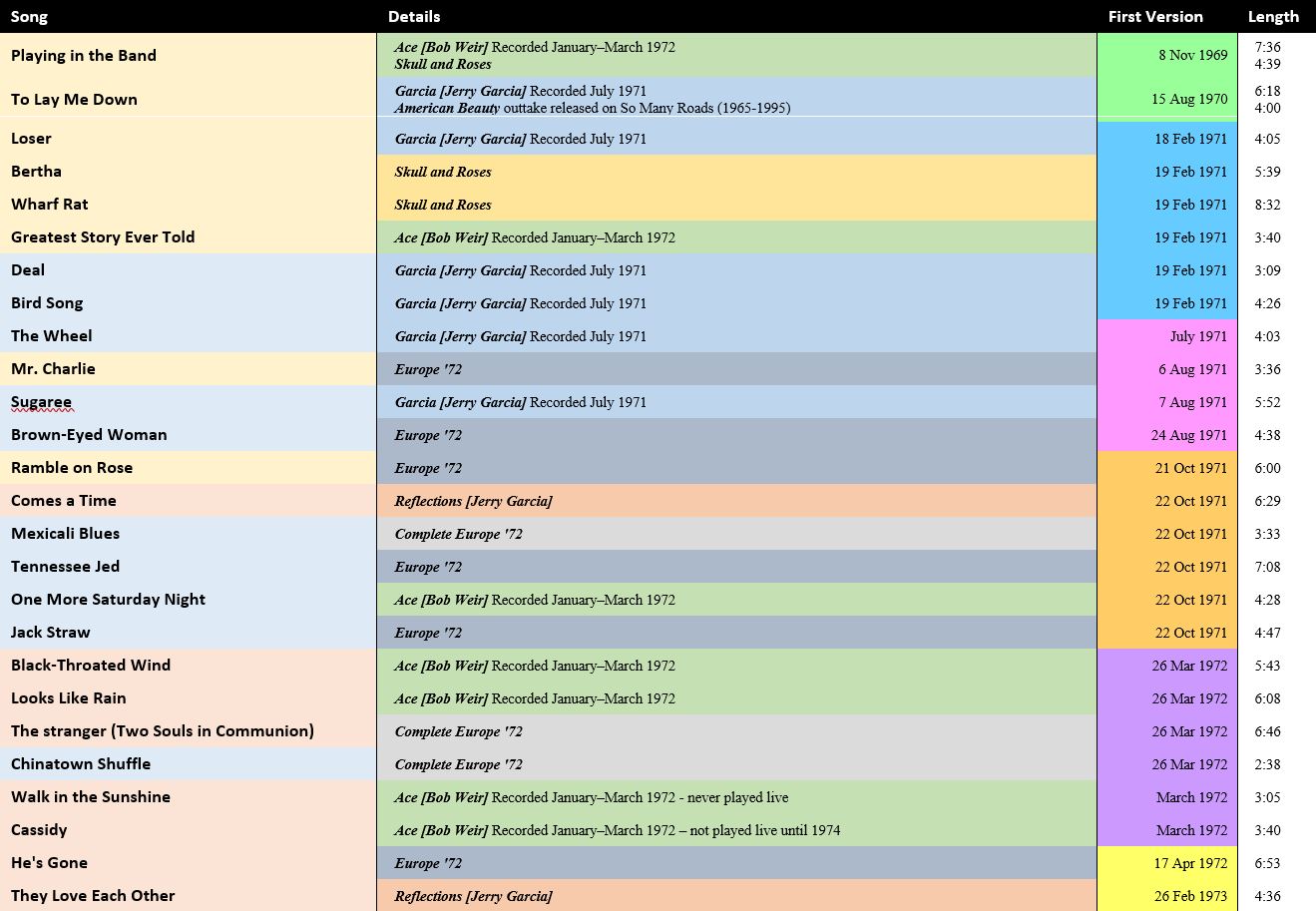
I then gather the pool of songs and sort those by whatever criteria is appropriate for the project. In this case I sorted them in chronological order by the date of the first appearance of the song whether it is the first live performance or first appearance on an album. The table below shows the song pool with the name of the song, where it comes from, the first appearance and the length of the track. I color coded each column to better visualize where each song can go. The basic rule of thumb is a later song cannot appear earlier, but an earlier song can be saved for later. There is a small margin to fudge things. Just because a song was first played live on one date doesn’t mean it was written the day before.


Once that’s done I start loading the songs into my sequencer. I use Magix’s Audio Cleaning Lab for this. It’s a nice program that allows me to shuffle the songs around, do some editing if needed and place track markers. It also has some decent mastering options (EQ, volume normalization, stereo field width and more) and the ability to burn the finished CD or export the tracks to most of the common digital formats.

I also make sure the project will fit on the appropriate medium. If it is from the pre-CD era I make sure that the tracks can fit on each side of a vinyl album. If it is for a CD it must be less than 80 minutes. I also consider song flow and try to start and end each side with the stronger songs.

I then export the tracks to dump onto my MP3 player or burn to a disc so I can evaluate the finished product. I usually need to go back and make adjustments until I consider it done. Song transitions usually need the most attention, especially with live albums.

Some time during all of this I make a cover if needed. I’m not very good with Photoshop or Gimp so I actually make all of my covers in MS Word. I have a template with a preformatted, one row, two column table for front and back covers. I insert pictures text boxes and word art then tweak until I’m happy. The results can be printed, or I take a screenshot and save it into the project folder.

Then the whole project is saved, tagged and added to the library for easy access from all my devices. Occasionally I’ll upload then them to a file sharing site so others can enjoy them.

Now, about those live albums. At the time the Dead treated live albums with the same care and attention as studio albums. They tried to include as much unique and new material as possible while keeping songs that appeared on previous albums to a minimum. This means that even though we removed all the new originals there is still a lot of previously unreleased songs left. Of course, those songs are all cover songs that would never make it on to a studio album. So, I took the leftovers and looked them over and to my surprise there was enough to save each album.

Each set was reduced by one disc, so Skull and Roses becomes a single disc of all covers with the exception of The Other One and Europe ’72 becomes a two disc set with a mix of covers and originals but no new originals. I did have to find one song to fill up side one of Europe’72. I used Beat it on Down the Line from the Bremen Beat Club session taken from the Europe ‘72 The Complete Recordings mega box set. I sequenced them as follows:

Skull and Roses
Side One
"Mama Tried" (Merle Haggard) 2:42
"Big Railroad Blues" (Noah Lewis) 3:34
"Me and My Uncle" (John Phillips) 3:06
"The Other One" (Bill Kreutzmann and Weir) 13:28
Side Two
"Big Boss Man" (Luther Dixon and Al Smith) 5:12
"Me and Bobby McGee" (Fred Foster and Kris Kristofferson) 5:43
"Johnny B. Goode" (Chuck Berry) 3:42
"Not Fade Away/Goin' Down the Road Feeling Bad" (Buddy Holly and Norman Petty/traditional) 9:14

In order to make side one fit I had to edit the Drums section in front of The Other One. Yea, I know, sacrilege. But if I didn’t then the side would have exceeded the limit by almost five minutes! I hate drum solos anyway so I don’t feel too bad about it. The edit works well and there is still a brief drum bit there for you drum heads to enjoy.

Europe '72
Side One
"Cumberland Blues" (Jerry Garcia, Robert Hunter, and Phil Lesh) 5:47
"China Cat Sunflower" (Garcia and Hunter) 5:33
"I Know You Rider" (trad., arr. The Grateful Dead) 4:55
“Beat it on Down the Line” 3:03
Side Two
"Sugar Magnolia" (Hunter and Weir) 7:04
"Hurts Me Too" (Elmore James) 7:18
"You Win Again" (Hank Williams) 3:54
Side Three
"Truckin'" (Garcia, Hunter, Lesh, and Weir) 13:08
"Epilogue" (Garcia, Donna Jean Godchaux, Keith Godchaux, Bill Kreutzmann, Lesh, McKernan, and Weir) 4:33
Side Four
"Prelude" (Garcia, Donna Jean Godchaux, Keith Godchaux, Kreutzmann, Lesh, McKernan, and Weir) 8:08
"Morning Dew" (Bonnie Dobson and Tim Rose) 10:35

Each side is between 18 and 19 minutes. Which matches the official release.

As you can see the process can take some time. It would be interesting to hear from others and their process. Just leave a comment if you want to share. If you have a similar blog or site, leave a link and I'll add it to the list on the right.

Sources
Skull and Roses - Released October 24, 1971
Garcia [Jerry Garcia] Recorded July 1971 – Released Jan 1972
Ace [Bob Weir] Recorded January–March 1972 – Released May 1972
Europe '72 - Released: November 5, 1972
Europe ‘72 The Complete Recordings
Reflections [Jerry Garcia] - February 1976
Reflections is Jerry Garcia's third solo album, released in 1976. Partway through production, Garcia stopped recording with his solo band and brought in the members of the Grateful Dead, who performed on four songs, plus a bonus jam from 2004 release. Three of the four Grateful Dead-performed songs had earlier live debuts: "Comes a Time" (1971), "They Love Each Other" (1973) and "It Must Have Been the Roses" (1974); "Might as Well" entered their rotation in 1976. Most of the songs entered the live rotation of the new Jerry Garcia Band as well. (Wiki)

Tuesday, October 31, 2017

Grateful Dead 1971 – 1973


In 1970 the Grateful Dead released two albums – Working Man’s Dead and American Beauty. In late 1973 they released the album Wake of the Flood. In between these LPs they released two live albums and three solo albums. 1972 was an especially busy and productive year in spite of the lack of new band studio albums. The live albums contained songs that became concert staples but were never recorded in the studio. What if instead of the live albums and the solo albums (which were mostly band recordings anyway) they released albums which were a mix of live and studio tracks? The premise would be that they would enhance the live tracks of new songs (the European tour was recorded on 16track) and those songs that needed more attention they would record fully in the studio.

This period is full of new songs that were scattered over those five albums (actually four, Mickey’s album was mostly instrumental and more experimental). I had recently read that there was talk at the time of a follow up to American Beauty to complete a trilogy of sorts that was centered around or named after the song Ramble on Rose. I took it upon myself to compile this album and truly fell in love with the period.

My first attempt turned into a double album. Those familiar with me might know of my disdain for double albums but this one worked. The song choice was purely my own taste. I did very little research beyond finding out which live songs were new and unrecorded. I arranged the songs to fit on four vinyl sides. It worked. It played nice. But it left me with a handful of still great songs leftover. The final tracklist was as follows:

Side A
1 Deal
2 One More Saturday Night
3 Jack Straw
4 Mr. Charlie
5 To Lay Me Down

Side B
1 Greatest Story Ever Told
2 Ramble On Rose
3 Tennessee Jed
4 Black-Throated Wind

Side C
1 Bertha
2 Sugaree
3 Looks like Rain
4 Loser

Side D
1 Cassidy
2 He's Gone
3 Playing In the Band
4 Bird Song

I posted the tracklist in a comment on soniclovenoize’s Albums That Never Were blog and somebody asked where The Wheel was. I had just come across the song They Love Each Other which sort of fit the timeline so I compiled a follow up LP with the following leftover songs.

Side A
1 Brown-Eyed Woman
2 Walk in the Sunshine
3 The stranger (Two Souls in Communion)
4 The Wheel

Side B
5 They Love Each Other
6 Chinatown Shuffle
7 Wharf Rat
8 Mexicali Blues

This is where things started to snowball. I started thinking “what if the double album was two single albums?”. I looked at the tracklists again and rearranged the disc sides of the double album. If they were to be single albums, then some songs would have to be moved.

Jack Straw was the most out of place. If the first LP would have been released late ’71 or early ’72 then we had an anomaly. Before the European tour Bob sang all the verses but by the end of the tour Bob and Jerry were trading verses. The version I used from Europe ’72 had Bob and Jerry trading verses. This meant that the side with Jack Straw (Side A) had to be moved to the second album. I swapped side A with side C which contained Bertha which was from the first live album in late ’71. I made new covers and dumped them onto my mp3 player for testing and everything seemed good.

Then I started researching and, well, then things got crazy. I had to go back to the drawing board and start over. Same song pool but now I looked into the time line of when each song was first performed or recorded. I am still discovering and finalizing things. I will post the results after the next project.